

You are scrolling through a group chat or a TikTok comment section and someone drops “ICL” out of nowhere. No explanation, no punctuation, just three letters sitting there. If you paused to figure out what it meant, you are not alone. ICL has become one of the most common shorthand terms in casual texting, and its meaning shifts depending on who sends it and where.
This guide breaks down every common meaning of ICL, how it shows up across platforms like Snapchat and WhatsApp, when it is safe to use, and how it compares to similar slang like TBH and NGL. By the end, you will never have to guess what ICL means again.
What Does ICL Mean in Text?
In everyday texting, ICL almost always stands for “I Can’t Lie.” People use it right before sharing an honest opinion, especially one that might feel a little blunt or unexpected. It works as a verbal flag that says, in short, “what I am about to say is genuine.”
A smaller but still common meaning is “I Care Less,” used to show indifference toward a topic. The two meanings sit at opposite ends of the emotional spectrum, so reading the sentence around ICL is the only real way to know which one applies.
| Meaning | What It Signals | Example |
| I Can’t Lie | Honesty, emphasis, sincerity | “ICL, that new show was actually really good.” |
| I Care Less | Indifference, detachment | “ICL about the drama, I’ve got better things to do.” |
ICL Meaning Slang in Different Contexts
Slang rarely stays fixed, and ICL is no exception. The core idea of honesty stays consistent, but the tone can shift depending on the conversation.
- In a compliment: adds sincerity, as in “ICL, you did amazing.”
- In a confession: softens an admission, as in “ICL, I forgot to text you back.”
- In an argument: can sound sarcastic or defensive depending on punctuation and capitalization.
- In a joke: sometimes used ironically, where the speaker clearly is exaggerating rather than being honest.
Capitalization also plays a small role. A lowercase “icl” in a casual message tends to read as relaxed, while all caps “ICL” often adds emphasis or urgency to the point being made.
Is ICL Rude, Offensive, or Neutral?
ICL is neutral on its own. It carries no profanity and no built in insult, unlike some other texting acronyms. Whether it feels rude depends entirely on the sentence attached to it.
“ICL, your idea kind of missed the point” reads as blunt but not hostile. “ICL, I don’t care what you think” leans closer to dismissive because of the words following it, not because of ICL itself. Treat it the way you would treat “honestly” or “not gonna lie” in a spoken conversation: harmless as a phrase, but shaped by everything said around it.
ICL Meaning in Text From a Girl
There is no different technical meaning when a girl sends ICL compared to anyone else, but the emotional weight can feel more personal in flirty or relationship texting. When it shows up in a conversation with romantic undertones, ICL usually signals that she is being unusually candid.
Common examples include:
- “ICL, I’ve been thinking about you all day.”
- “ICL, that was actually a really sweet thing to say.”
- “ICL, I’m nervous about this.”
In these cases, ICL is less about slang trendiness and more about lowering her guard for a moment of honesty.
Where Is ICL Commonly Used?
ICL shows up across nearly every major messaging and social platform, though the tone shifts slightly depending on where you see it.
| Platform | Typical Usage |
| TikTok | Comments and captions expressing a genuine reaction |
| Snapchat | Quick, casual honesty between friends |
| Caption openers or DM replies | |
| Personal chats, often between close contacts | |
| Discord | Gaming and community chats, sometimes with a joking tone |
| X (Twitter) | Short posts adding weight to an opinion |
ICL Meaning Slang in Real Life Conversations
Outside of texting, people have started saying ICL out loud, spelling it letter by letter rather than pronouncing it as a word. It usually appears mid sentence as a quick honesty marker.
- “ICL, I wasn’t expecting that.”
- “Ngl, ICL, I actually liked the movie.”
- “ICL though, that test was harder than I thought.”
This spoken version mirrors how “literally” or “honestly” get dropped into casual speech without much thought, filling a small conversational gap rather than carrying deep meaning.
Emotional and Psychological Meaning of ICL
Language researchers who study digital communication point out that short honesty markers like ICL exist because text lacks tone of voice. Typing “ICL” mimics the effect of pausing before a sentence in real conversation, signaling that the speaker is about to be sincere or vulnerable.
Psychologically, using ICL can also serve as a small confidence booster. It gives the sender a way to soften a confession or admission before it lands, almost like a verbal cushion. That is part of why it appears so often before statements people feel slightly unsure about sharing.
Origin and Background of ICL
ICL grew out of the same wave of internet shorthand that produced acronyms like TBH and NGL. As texting speeds increased and character limits shaped platforms like early Twitter, users leaned on compressed phrases to communicate quickly. ICL followed the same pattern, trimming “I can’t lie” down to three keystrokes.
It gained traction through youth focused platforms, spreading through comment sections and reaction videos before settling into mainstream texting vocabulary by the mid 2020s.
ICL Meaning in WhatsApp
On WhatsApp, ICL tends to appear in more personal, one on one conversations rather than group settings, since the platform skews toward close contacts and family. People use it the same way as everywhere else, most often to preface an honest opinion or reaction.
A typical WhatsApp message might read: “ICL, I forgot we had plans today, so sorry.” The meaning does not change on this platform, but the tone often feels a touch more sincere because WhatsApp conversations are frequently between people who already know each other well.
Comparison With Similar Slang
| Term | Full Meaning | Tone |
| ICL | I Can’t Lie | Honest, sometimes vulnerable |
| TBH | To Be Honest | Neutral, straightforward |
| NGL | Not Gonna Lie | Blunt, slightly stronger than TBH |
| IDC | I Don’t Care | Casual indifference |
| FR | For Real | Emphasis, agreement |
ICL sits closest to NGL in tone, though ICL often feels a little more personal because it directly references lying rather than simply flagging honesty.
Also Read This: WTV Meaning in Text: What Does WTV Mean in Texting & Slang? (2026)
When Should You Use ICL?
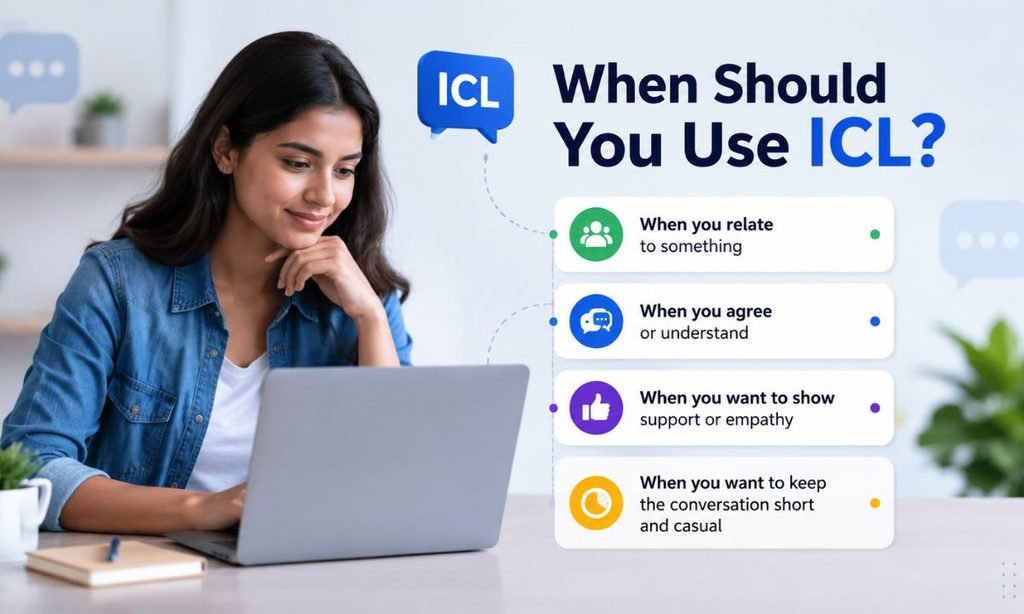
ICL fits naturally into casual, low stakes conversations, especially with friends, partners, or people you already text regularly. It works well when:
- You want to share an honest opinion quickly.
- You are softening a confession or admission.
- You want to add emphasis to a compliment or reaction.
- The conversation is informal and relaxed.
When Should You Avoid Using ICL?
Some settings call for more formal language, and ICL can come across as out of place or unprofessional in those spaces.
- Work emails or messages to a boss
- First conversations with someone you barely know
- Serious or sensitive discussions where slang could feel dismissive
- Messages to older relatives who may not recognize the acronym
Polite Alternatives to ICL
If you want the same honest tone without the internet slang feel, try:
- “Honestly”
- “To be honest”
- “I’ll be straight with you”
- “Truthfully”
These phrases carry the same intent while staying appropriate for more formal or mixed audiences.
Why Do People Use ICL?
People reach for ICL because it does a lot of communicative work in very few characters. It signals sincerity instantly, speeds up typing, and fits the fast, casual rhythm of modern texting and social media captions. It also carries a sense of shared culture, since using current slang correctly can make a message feel more relatable and current.
Impact of Using ICL in Communication
Used well, ICL can make a message feel warmer and more genuine. Used carelessly, especially in professional or unfamiliar settings, it can come across as too casual or even flippant. The impact largely depends on audience: close friends read it as natural honesty, while unfamiliar readers may need context clues to interpret the tone correctly.
Is ICL Safe for Social Media?
Yes, ICL is considered safe and widely accepted across mainstream social platforms. It contains no profanity, no hidden offensive meaning, and no age restriction concerns. Brands and casual accounts alike use it in captions without any real risk of misinterpretation, as long as the surrounding message stays appropriate.
Common Misunderstandings About ICL
- Confusing it with IRL, which means “in real life” and has nothing to do with honesty.
- Assuming it always means the same thing regardless of context.
- Treating it as rude by default, when the surrounding words are usually what set the tone.
- Missing that ICL also has unrelated meanings outside slang, such as in banking or medical contexts where it refers to specific industry terms.
Variations and Types of ICL Usage
- Standalone opener: “ICL, that was unexpected.”
- Mid sentence emphasis: “That was, ICL, one of the best meals I’ve had.”
- Paired with other slang: “Ngl, icl, I’m actually impressed.”
- Spoken aloud, letter by letter, in casual conversation.
How to Respond When Someone Uses ICL
There is no special reply required. Respond to the content of the message the same way you normally would, since ICL is simply framing rather than changing the core meaning. If someone says “ICL, I think you were wrong,” a normal reply might acknowledge the point directly rather than reacting to the acronym itself.
Regional and Cultural Usage
ICL is widely understood across English speaking regions, including the United States, United Kingdom, Canada, and Australia. Usage patterns are largely similar worldwide thanks to shared exposure through global social media platforms, though it tends to appear more frequently among younger users regardless of country.
Conclusion
ICL is a small acronym that carries a surprising amount of emotional weight. Most of the time, it means “I Can’t Lie,” a quick way to flag honesty before sharing an opinion, confession, or reaction. Less often, it flips to mean “I Care Less,” signaling indifference instead.
Context is always the deciding factor. Read the message around ICL, consider the platform, and think about your relationship with the sender, and the meaning becomes clear almost instantly. Once you understand that simple rule, you will never have to pause and wonder what ICL means again.

Harrison is a passionate writer and researcher behind StyleFitts.com, dedicated to exploring meanings, word origins, and language trends. He creates clear and informative content that helps readers better understand modern expressions and their deeper significance.